
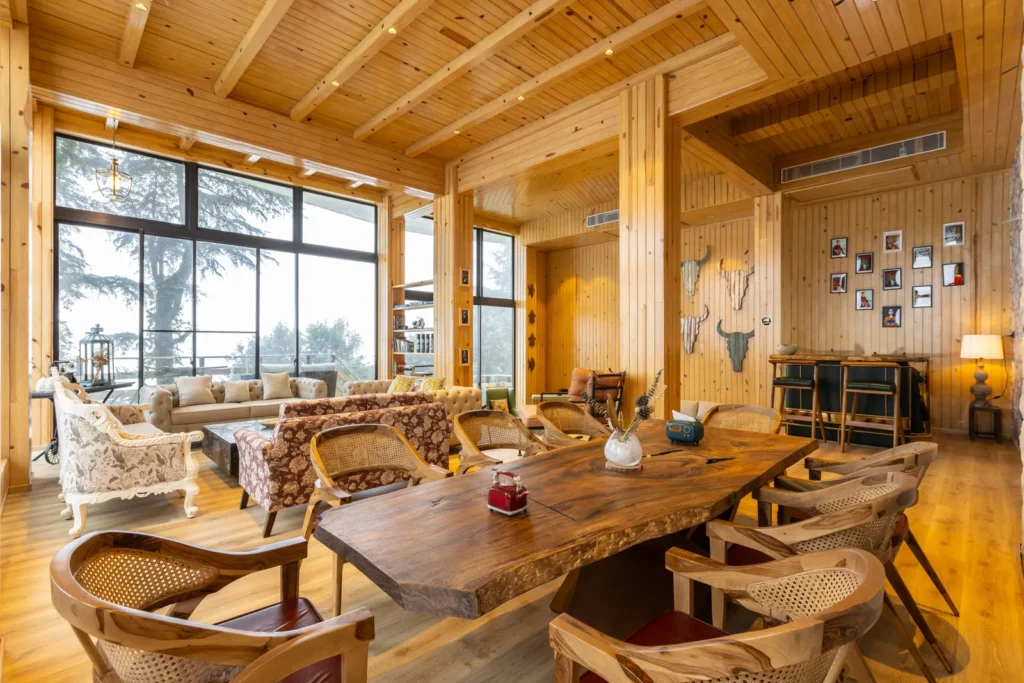
Contemporary interior architecture increasingly centers on human connection to the natural world. Known widely as biophilic design, this movement moves beyond the superficial placement of potted plants to create tactile, sensory environments that reduce cognitive stress and elevate daily living. Within this design framework, organic timber from northern latitudes plays an indispensable role. When designers seek understated elegance paired with structural resilience, ethical workshops like the Frellio wooden lighting studio demonstrate how regional raw timber transforms into sculptural focal points that celebrate quiet luxury.
The Tactile Resonance of Baltic Timber
Northern forests present unique climatic conditions characterized by short growing seasons and prolonged, freeze-heavy winters. These demanding environmental factors force native birch trees to grow exceptionally slowly, producing dense, uniform rings and fine-grained resilience. When converted into precision-engineered ply, Baltic birch offers unrivaled dimensional stability, remaining resistant to warping under fluctuating indoor ambient temperatures.
Visually, the light honey tone and subtle wave-like grain provide an architectural blank canvas that softens modern concrete, glass, and steel structures. Rather than overwhelming a room with heavy, dark hardwoods, pale birch preserves spatial luminosity, maximizing available daylight even throughout the darkest northern winter afternoons.
Designing for Visual Warmth and Luminance
Lighting remains the central pillar through which materials communicate mood and geometry. In biophilic compositions, illumination must do more than simply banish shadows; it must emulate the restorative quality of dappled forest sunlight. Crafting fixtures from cross-laminated timber allows light to interact with organic surfaces before washing across the living space.
Curating spaces with sustainable Scandinavian birch plywood lighting creates a layered interplay of illumination and shadow. Because the interior faces of sliced wood retain their microscopic porous texture, light refracts through the shade with a warm, amber diffusion rather than the harsh glare typical of industrial sheet metal or cold synthetic polymers.
- Dynamic shadow casting mimicking tree canopies
- Gentle filtration that shields direct eye exposure from bright LED bulbs
- Neutral color rendition that complements wool textiles, raw linen, and stone
- Visual weight reduction through slender, curved profiles
Focal Illumination in High Ceiling Volumes
In open-concept residences and loft-style spaces, lighting fixtures frequently anchor seating islands, dining areas, or central corridors. A common challenge involves choosing an overhead installation that commands presence without interrupting architectural sightlines. Large volumetric designs executed in solid timber can feel visually overbearing, while mass-produced metal pendants often look detached from natural interior finishes.
Precision joinery solves this dilemma by interlocking lightweight, curved ribs of Baltic birch into three-dimensional geometric structures. An exemplary application of this discipline is the Solan handcrafted ceiling light, which employs repetitive structural fins to encase the light source, casting delicate radial patterns across surrounding ceiling planes while remaining remarkably light and airy.
Sustainable Crafting and Circular Design Values
Biophilic design loses its moral foundation if material sourcing degrades the habitats it seeks to emulate. True sustainability in contemporary furniture craft requires a rigorous, closed-loop approach across every phase of production. Because timber serves as a natural carbon sink, responsibly managed harvesting preserves the ecological vitality of northern forestry belts.
- Selecting certified timber from responsibly managed regional reserves
- Maximizing laser and CNC cutting layouts to virtually eliminate raw offcut waste
- Utilizing low-emission, non-toxic waterborne bonding agents
- Designing flat-pack or modular joinery to minimize packaging volume and freight emissions
By prioritizing raw material provenance, modern designers avoid synthetic composites and vinyl laminates that off-gas volatile organic compounds into enclosed residential spaces. Birch plywood coated with water-based eco-sealants retains its natural breathability while protecting surfaces from premature UV fading.
Integrating Natural Wood into Contemporary Nordic Layouts
Successfully integrating Baltic birch fixtures into an interior requires deliberate attention to balance, material palette, and surrounding textures. When wood elements are distributed thoughtfully, they bring cohesive grounding rather than visual monotony.
Architects frequently recommend pairing smooth birch finishes against rougher structural elements, such as lime-washed plaster, honed limestone, and brushed brass accents. In minimalist dining zones or meditative study areas, an organic wooden luminaire hanging suspended over an unstained oak table generates visual harmony through subtle tonal variation. The deliberate balance between structured geometry and organic grain satisfies the human need for natural refuge, proving that sustainable craftsmanship remains the ultimate foundation of enduring interior architecture.