
You don’t always notice changes in your household water immediately. Sometimes, it’s a slightly unusual taste that catches your attention. Other times, it’s the stubborn residue around bathroom faucets or the faint odor that becomes particularly noticeable during a warm shower. Individually, these things might seem insignificant, but dealing with them every day can become frustrating.
Investing in appropriate water quality testing and treatment helps homeowners understand what’s causing these concerns rather than spending money on equipment that may not address the underlying problem.
The good news is that improving household water doesn’t necessarily require complicated technology or an expensive installation.
It begins with understanding what’s flowing through your pipes and determining which improvements would genuinely make a difference to your daily life.
What Can Water Testing Tell You About Your Home?
Water contains various naturally occurring minerals, dissolved substances, and occasionally suspended particles. Its composition depends on its source, surrounding environmental conditions, and the plumbing it travels through.
Calcium and magnesium contribute to water hardness. Iron may be associated with reddish stains, while disinfectants used in municipal treatment can sometimes influence taste and odor.
However, water quality isn’t something you can reliably judge by appearance alone.
A perfectly clear glass of water may contain substances that require attention. Meanwhile, water that leaves mineral deposits isn’t necessarily unsafe to drink.
Basic screening can provide information about certain characteristics, including hardness and pH. More comprehensive laboratory testing may be necessary to identify specific contaminants.
Understanding these results gives you a reliable foundation for choosing suitable treatment equipment without relying on assumptions.
Why Professional Guidance Can Save Time and Money
Choosing water treatment equipment can feel overwhelming, particularly when several products appear to offer similar benefits.
One system promises better-tasting water, another focuses on mineral reduction, and a third claims to address numerous household concerns.
Experienced providers of professional water treatment services can help homeowners evaluate their water conditions, understand available technologies, and select equipment that reflects their property’s requirements.
Consider a homeowner struggling with orange stains around bathroom fixtures. Purchasing an ordinary carbon filter might seem reasonable, but specialized iron treatment could be more appropriate depending on the test results.
Similarly, a water softener won’t necessarily resolve an unpleasant chlorine taste.
Professional guidance helps distinguish between these concerns while taking household consumption, installation space, and maintenance requirements into account.
Sometimes, the most effective recommendation is also the simplest one.
When Treating Water Throughout the Entire Home Makes Sense
Many homeowners initially invest in a drinking water filter because the kitchen is where water quality concerns become most noticeable.
But what happens when similar problems appear in the bathroom, laundry room, and other areas of the property?
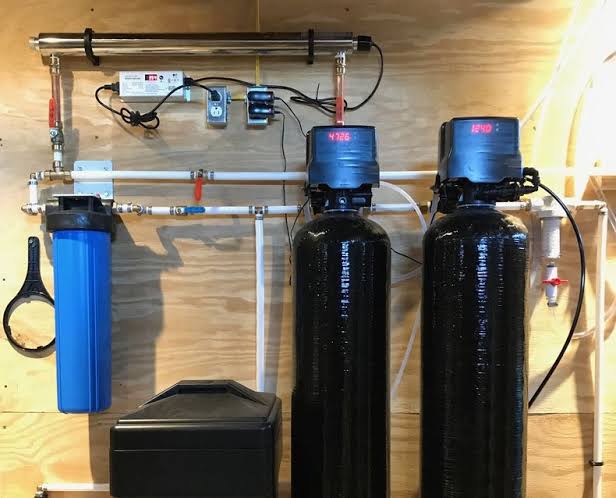
Installing a suitable whole house filtration system allows incoming water to be treated near the main supply connection before traveling through connected household plumbing.
Depending on its design, centralized treatment may help reduce suspended particles, certain odors, and other targeted contaminants throughout the property.
This arrangement also eliminates the need to maintain numerous individual filters at different fixtures.
However, comprehensive filtration isn’t necessary for every household. If your primary concern is drinking water quality, a dedicated under-sink system might provide a more economical solution.
Consider where your water-related problems occur before deciding how extensively treatment is needed.
Understanding the Different Roles of Filters and Softeners
Water filters and softeners are often mentioned together, but they aren’t interchangeable.
Sediment filters capture suspended materials such as sand, dirt, and rust particles. Activated carbon filters can reduce certain undesirable tastes, odors, and contaminants.
Water softeners primarily address hardness minerals through ion exchange, helping limit future scale formation inside plumbing components and certain appliances.
Reverse osmosis systems use membrane separation to reduce various dissolved substances, making them useful for specific drinking water applications.
Each technology has its strengths and limitations.
For example, installing an ordinary carbon filter probably won’t prevent chalky deposits from returning to your kettle.
Matching treatment technology to actual water conditions is considerably more important than purchasing equipment with an impressive list of features.
How Suitable Water Treatment Can Improve Everyday Life
The benefits of better water often appear in surprisingly ordinary moments.
Perhaps your morning tea tastes more enjoyable, or cleaning bathroom fixtures becomes less demanding after addressing excessive water hardness.
Reducing suspended particles may also help prevent debris from accumulating in faucet aerators and certain plumbing components.
These improvements might not seem particularly dramatic, but their value becomes apparent when experienced repeatedly.
For households with specific drinking water concerns, appropriately selected equipment with verified contaminant reduction capabilities may provide additional protection.
Nevertheless, realistic expectations matter. No single treatment system can automatically resolve every possible water quality problem.
Considering Maintenance Before Purchasing Equipment
Installing a treatment system is only the beginning. Keeping it effective requires ongoing attention.
Sediment cartridges gradually collect debris, carbon media eventually lose their treatment capacity, and reverse osmosis membranes may require periodic replacement.
Before purchasing equipment, ask about servicing intervals, replacement component costs, and maintenance accessibility.
Incorrectly sized or neglected filters can restrict water flow and create additional household frustrations.
Periodic testing is particularly important when treatment is intended to reduce potentially harmful contaminants. Ordinary filtration should never automatically be assumed to make unsafe source water drinkable.
A manageable maintenance routine helps protect both equipment performance and your investment.
Better Water Starts With Better Information
Improving household water quality doesn’t need to become an unnecessarily complicated project.
Start with appropriate testing, identify your priorities, and choose treatment equipment based on verified performance rather than broad promises.
The right system should address genuine concerns while fitting comfortably into your household routine.
Water touches countless moments throughout the day, from preparing breakfast to washing dishes after dinner. Giving its quality some thoughtful attention can make those everyday experiences more enjoyable and convenient for years to come.